
The ground itself
Os Vilares is a small parish in the municipality of Guitiriz, in the province of Lugo — inland Galicia, far from the Atlantic coast and its bardic granite. The country here is the Terra Chá: a broad, damp plain sitting at modest elevation, crossed by rivers that have not yet found enough gradient to hurry. Eucalyptus and pine break the horizon; bog and meadow fill the foreground. It is not a landscape of drama. Its qualities are patience, wetness, and a particular quality of light that does not so much illuminate as diffuse.
Xosé María Díaz Castro ↗ was born here in 1914, and the place did what places do to writers who grow up inside them and then leave: it became a register as much as a memory. When he wrote in Galician, he wrote in the speech of this flat country, and the poems in Nimbos carry the sound of Terra Chá even when their subjects are metaphysical — light, faith, time, the persistence of the dead.
Guitiriz and its radius
Guitiriz itself is a small town, the municipal centre for a scattering of parishes of which Os Vilares is one. The area sits in the interior of the province of Lugo, loosely oriented toward the city of Lugo to the south and the episcopal town of Mondoñedo to the northeast. Mondoñedo mattered: it was there that Díaz Castro received his early seminary education, moving from the rural parish into a more formally literary environment while remaining within the linguistic territory of inland Lugo.
The speech of Guitiriz belongs to the block of Galician varieties spoken across the central and eastern interior — varieties that differ from coastal Galician in vowel quality, in certain lexical choices, and in the rhythm of ordinary conversation. A poet who grew up hearing that speech and then spent decades working in Madrid was carrying something precise and irreplaceable: not simply Galician as a written standard, but a spoken texture that predates any normativa, the term for the orthographic and grammatical standards eventually codified for the language. That texture is audible in Nimbos to readers who know where to listen, and it is one of the things that makes the book resistant to easy translation.
The flat country as poetic fact
The landscape of the Terra Chá is not neutral backdrop. The flatness means that sky dominates: there is more of it visible here than on the coast or in the mountain parishes of the Cordillera Cantábrica's foothills. Díaz Castro's poems return repeatedly to light — its sources, its failures, the way it falls on ordinary things and briefly makes them strange. That preoccupation is not purely theological, though it is that too. It is also the observation of someone who grew up under a wide, grey, frequently overcast sky in which the appearance of real light was an event worth remarking.
Rosalía de Castro drew her Galician landscapes from Padrón and the Sar valley, from the coast and the pilgrim road. Eduardo Pondal built his bardic register out of Ponteceso and the Costa da Morte. Díaz Castro's interior is quieter and less immediately legible as symbol, which may be one reason Nimbos took longer to find its readers. The Día das Letras Galegas did not reach him until 2014 — more than twenty years after his death, and more than fifty years after Nimbos was published by Editorial Galaxia ↗ in Vigo in 1961.
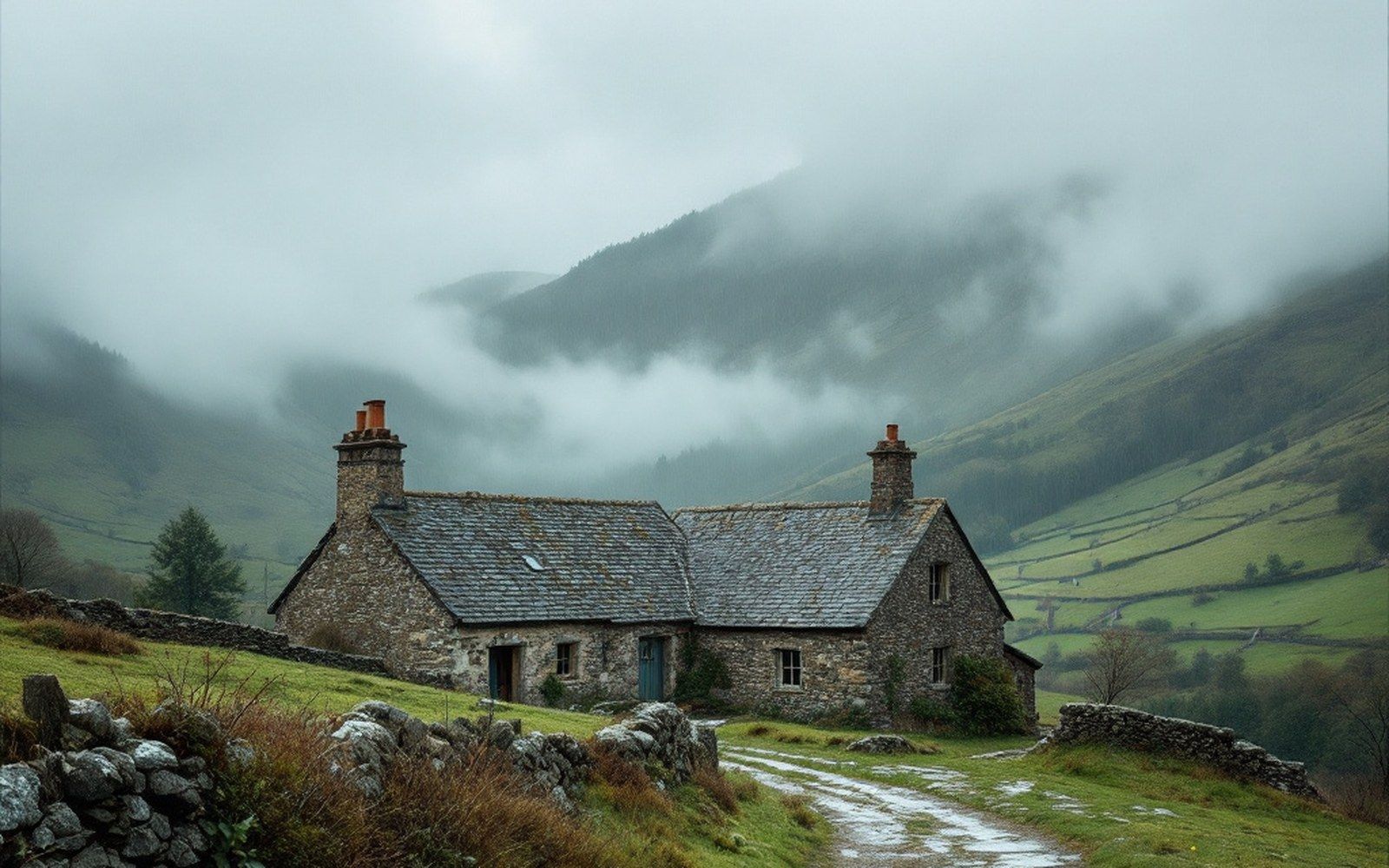
What Os Vilares gave him cannot be reduced to local colour. It gave him a specific phonology, a particular relationship to silence and space, and the stubborn habit of noticing what the flat country notices: not the spectacular, but the persistent. Those are the conditions under which Nimbos was written, even if the book was composed far from the parish, in the working life of a translator in Madrid. The ground stays in the voice long after the body leaves it.
Its qualities are patience, wetness, and a particular quality of light that does not so much illuminate as diffuse.